Glucose

It’s been a while… Hello people! School has been strenuous but we are moving through.. How are you?! Hope you are nice

I read something this morning, still physiology. You should know already this is my favorite course 😂. Digestion of carbohydrates. Honestly I had read this in biology in secondary school a gazillion times and it still fascinated me. This morning I got a little more in depth and decided to share.

Whenever you take a spoon of rice or you chewing on that potato. Ever wondered what actually happens to it in the body. Let’s find out. The whole process begin when we boil our rice or fry our French fries. The reason for cooking is the break down the part of the food we can’t digest called cellulose. Cellolose is usually found in non animal food (plants). Once it’s broken down we can access the other nutrients in the food. Now the food is ready and we put a spoon in mouth. Immediately saliva is produced in large amounts (how that is done is a topic for another day) the saliva has a lot of constituents but the one needed right now is called ptylain : alpha amylase. This acts on the food for the few seconds while it’s in your mouth(about 5% of your food is digested in your mouth) down to the fundus of the stomach. It takes about an hour for the food to mix with the gastric juice,once the gastric juice mixes with it the action of ptylain stops because the enzyme(a substance that makes a reaction go faster that usual) becomes inactive at a ph of 4 and the ph of the stomach is about 2.0 -3.0. Once the food leaves the stomach into the duodenum (small intestine) it changes its name to chyme. The chyme is acted upon by pancreatic amylase. It has the same function has ptylain but it is way more powerful within 15-30 on arrival the whole of the chyme becomes digested

At this point. The digested food needs to be hydrolyzed(breaking them down to their simplest form that can be absorbed) . The small intestine has villi and microvilli with a brush border(hair like border) which secretes enzymes known as lactase which works on lactose, maltase that works on maltose and sucrase that work on sucrose. Lactase converts lactose to glucose and galactose, sucrase coverts sucrose to fructose and glucose and maltase converts maltose to multiple polymers of glucose. The highest end product of carbohydrates is glucose!

I hope you could understand! Tell me how well I did❣️ Still trying to explain why the body works the way it does and how it does it

With love,

Mojoyinoluwa

My reference is and always will be my Guyton and hall physiology textbook

Varicose veins

Hello people! This week has been a whole lot, A plethora of work! I left so much work undone during the holidays, I am feeling the after effects now. Was it worth it? Was I just been extremely lazy? I mean I was just managing, no, striving is the word to get through every day last semester. A month of no reading couldn’t hurt 😂😂that’s what I thought.

It’s  February now and it’s seems like my life is seeping away with every topic I read  to make it worse I have to keep up with the new classes. I can! I tell myself that every day and I will! Trust me!. Mind over matter. Medical students struggles.
This morning, I picked up physiology, it’s my new favorite course. It used to be anatomy till it started behaving waywire😑. We took cardiovascular block last semester and I was reading it up, wrapping it up and I came across varicose veins for the umpteenth time and I felt why not share it?!


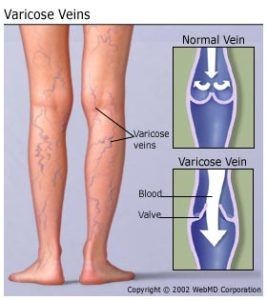
Ever wondered why that nurse had  blue colored stuff at the back of his or her legs shaped like worms those worm like stuff are actually veins!
Our veins have two extensions from the both sides of the internal membrane called valves. This valves help us take blood back our hearts thereby preventing backflow of blood. Due to gravity, it is almost impossible for blood in the veins to return to the heart especially when we are standing because the force of gravity drags or brings everything back to the center of earth. The valves help us break that rule! Cool right! and everytime our muscles contract this valve open up and blood moves upward then the valves closes to prevent backflow.  Sometimes when we stand absolutely still for too long, pressure builds up in this veins especially veins closer to the ground like the ones in the legs. The pressure starts to build in the legs because the muscles are not contracting. This excessive pressure causes the veins stretch but the valves don’t increase in length so during relaxation of muscles when they are supposed to close they not longer meet, at this point the valves becomes incompetent and backflow of blood begins to occurs. The backflow of blood leads even more increase in pressure causes even greater distension/stretching of the the veins till they lose their functions. Now this veins are called varicose veins.
Should we really be standing at assemblies?! I mean the body prefers we sit! We need to have this talk but the school officials aren’t ready.. For someone who loves the baby girl life this is an addition to my campaign 😂
The most preferred treatment for varicose veins is to continually elevate the legs to as high as the heart and wearing tight binders or compression stockings.
I hope you understood what I said 😂😂I love to hear from you on how to make my post/writings better or what you want me to write on. See you soon!
                                         With love,
                              Mojoyinoluwa ❤️
P. S my reference is my textbook Guyton and hall physiology! And pintrest for pictures!

Welcome….

Hello people, I decided to start a blog. It’s been on my mind for a long long time now and I finally got that extra push today.. I am scared not gonna lie! Will it work? Will it not? But we move anyways 😂I am a medical student and I’ll love to share new stuff I find out while learning, studying everything on our health, bodies and how they work

I promise fascinating updates every Friday every two weeks. This is so new to me but I am taking the ride anyway so should you!

We move!

Design a site like this with WordPress.com
Get started